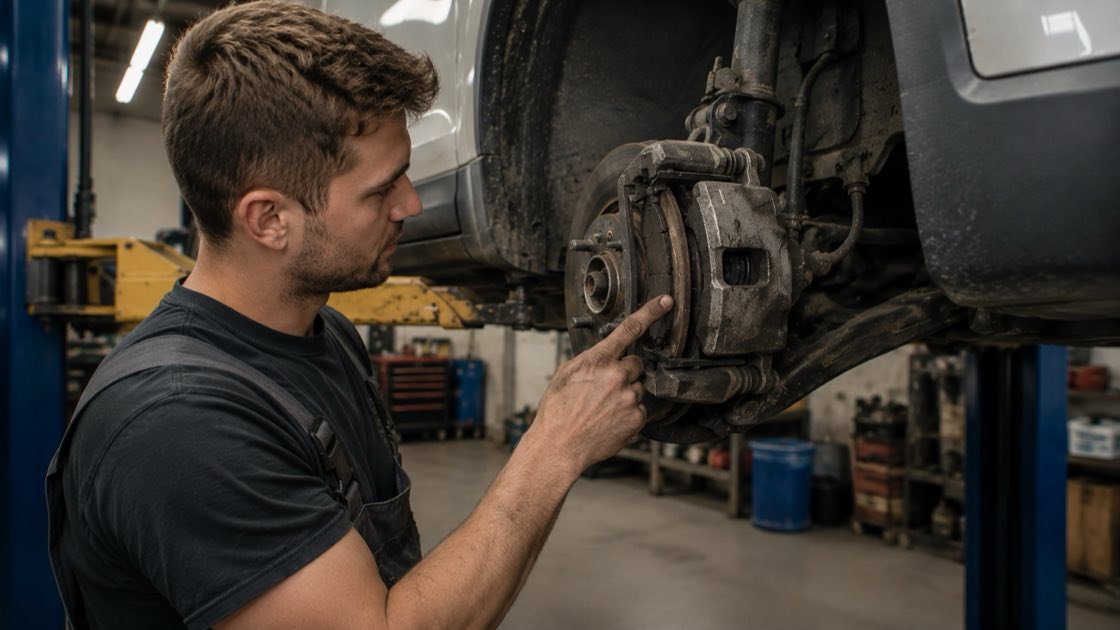
How Dad would explain it
You need new brake pads when you hear a high squeal every time you slow down, your stopping feels softer, or you can see the pad is thin. The squeal is a little metal tab telling you the pad is getting low and it’s time to plan a visit. A grind is different and worse: that’s metal on metal, so come in right away. If you’re not sure, swing by the shop on Cascade Road for a free brake inspection and we’ll measure them for you.
Brake pads are the part that does the actual stopping. They’re a block of friction material that squeezes the spinning rotor (the metal disc behind your wheel) to slow you down. Every stop wears a little off them, like tread off a tire. Eventually there’s not enough left, and that’s when you need new ones.
This post is about the signs your brake pads specifically are worn out. If your trouble is something else, like a pulsing pedal or a brake light that won’t quit, we cover that in common brake problems and what they mean. Here we’re sticking to pad wear.
One note before the signs: down here in Southwest Atlanta, a lot of our customers do short stop-and-go trips. Errands around the West End, school runs near Adair Park, crawling up Cascade Road at 5pm. That kind of driving eats pads faster than steady highway miles, so if yours wear quick, you’re not imagining it.
1. A high squeal when you slow down
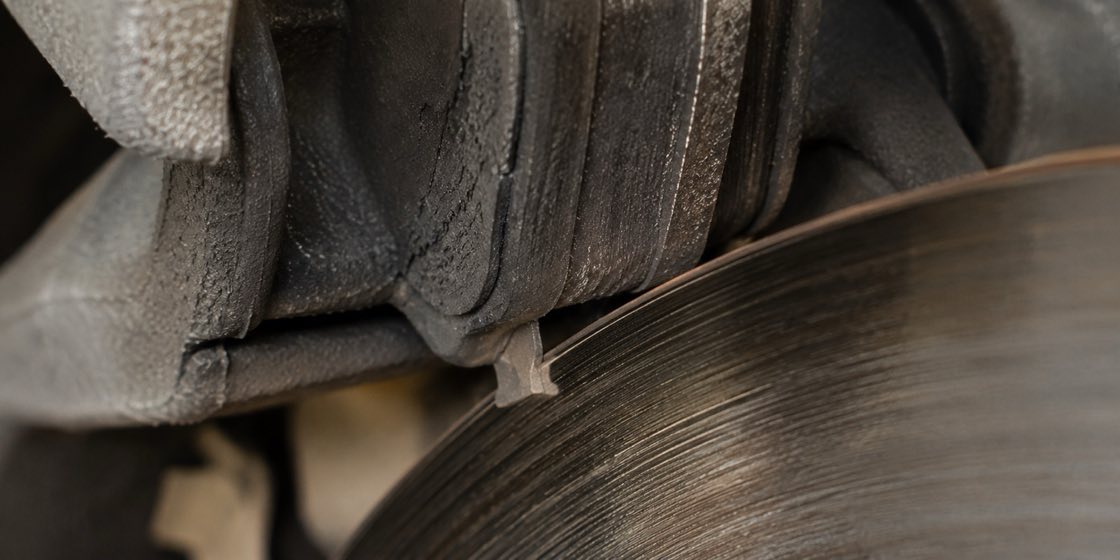
This is usually the first thing folks notice, and it’s the one to know. Most pads have a little metal tab built in called a wear indicator. When the pad gets thin, that tab touches the rotor and makes a high squeal every time you brake. It’s annoying on purpose. It’s the pad asking for attention.
Here’s the honest part: a squeal means it’s time, not emergency. The pads still work. You’ve got room to plan a visit instead of panicking. But don’t let it ride for months, because the next stage costs more.
If you hear that squeal around West End or Greenbriar, give us a call or book online and we’ll measure the pads.
2. A grinding sound when you brake
Grinding is not squealing, and it changes everything. Squeal is a warning. Grind means the pad material is gone and bare metal is dragging on the rotor. That’s metal on metal.
When that happens, you’re chewing up the rotor, which turns a pad job into a pad-and-rotor job. If it were our own car, we’d stop driving it as much as we could and bring it straight in. Grinding is the one sign on this list where the answer is “come in now,” not “come in soon.”
3. You can see the pad is thin
You don’t need to be a mechanic for this one. Look through the spokes of your wheel and you can usually spot the pad pressed against the rotor. If that friction material looks thinner than about a quarter inch, it’s getting close. Once it’s down near an eighth of an inch, it’s replacement time.
Not sure what you’re looking at? Here’s a guide on how thick a healthy brake pad should be, and one on what a worn pad actually looks like. Or just bring it by Cascade Road and we’ll measure it free.
4. Longer, softer stops
When pads wear down, you lose a little stopping power, and it sneaks up on you. The car takes a hair longer to stop, or the pedal feels softer than it used to. Most folks get used to it without noticing, then they get new pads and can’t believe how much firmer the brakes feel.
Worn pads are one cause of this. A soft pedal can also point to a fluid or hydraulic issue, which isn’t a pad problem. Either way it’s worth a look, especially before a wet drive home down Cascade in the rain.
5. The car pulls to one side when you brake
If the car tugs left or right when you press the brake, one side’s pads may be wearing faster than the other, or a caliper may be sticking. Brakes should feel even and straight. A pull means something’s uneven, and worn pads on one corner is a common reason. We’ll check both sides and tell you which it is.
6. A burning smell after braking hard
Caught a sharp, hot smell after riding the brakes down a hill or sitting in stop-and-go traffic? Worn pads run hotter because there’s less material to absorb the heat, so they overheat sooner. An occasional whiff after a steep descent can be normal. A smell that keeps showing up is worth checking. Don’t keep driving hard on hot brakes.
7. More brake dust or a thin pad on one wheel
Pads shed dust as they wear, and a wheel throwing a lot more black dust than its partner can mean that corner’s pad is working harder and wearing faster. Pair that with any squeal or a thin-looking pad and it’s a good sign you’re due. It’s a small clue, but it’s a real one.
What new brake pads cost at Dad’s
We like to put real numbers out front so there are no surprises.
- Brake pads start at $180 per axle (front or rear).
- Pads and rotors together run about $350+ for the front and $400+ for the rear, since rear setups often have a bit more going on.
- Labor is $95 an hour, and most pad jobs are a couple of hours.
Our house pads are OEF3 brake solutions, which is just a solid, dependable pad we trust on our own vehicles. Every pad job is backed by our 10-month / 10,000-mile warranty, whichever comes first. And every visit includes a free brake inspection, so even if you just want a measurement, that part doesn’t cost you anything. You can see the full breakdown on our pricing page or read more on front brake pad replacement cost.
We’re not here to scare anybody into work they don’t need. If your pads still have life, we’ll tell you straight and send you on your way. That’s how we’d want to be treated.
Frequently Asked Questions
How long do brake pads usually last?
Most pads go 30,000 to 70,000 miles. Short stop-and-go driving around Southwest Atlanta wears them on the lower end of that range, so check sooner rather than later.
Is squealing always a sign I need new pads?
Usually, yes. That high squeal is most often the wear indicator telling you the pad is thin. Come by for a free measurement to be sure.
Can I drive with grinding brakes?
We wouldn't. Grinding means metal on metal, and every mile risks damaging the rotor and turning a pad job into a pad-and-rotor job. Bring it in right away.
How much do new brake pads cost?
Pads start at $180 per axle. If the rotors are worn too, figure around $350+ front or $400+ rear. Labor is $95 an hour, and we'll always show you what we see first.
Do you offer a warranty on brake pads?
Yes. Our pad work is covered by a 10-month / 10,000-mile warranty, whichever comes first.
How long does a brake pad replacement take?
Most are done in a couple of hours, depending on the condition of the rotors and the rest of the system.