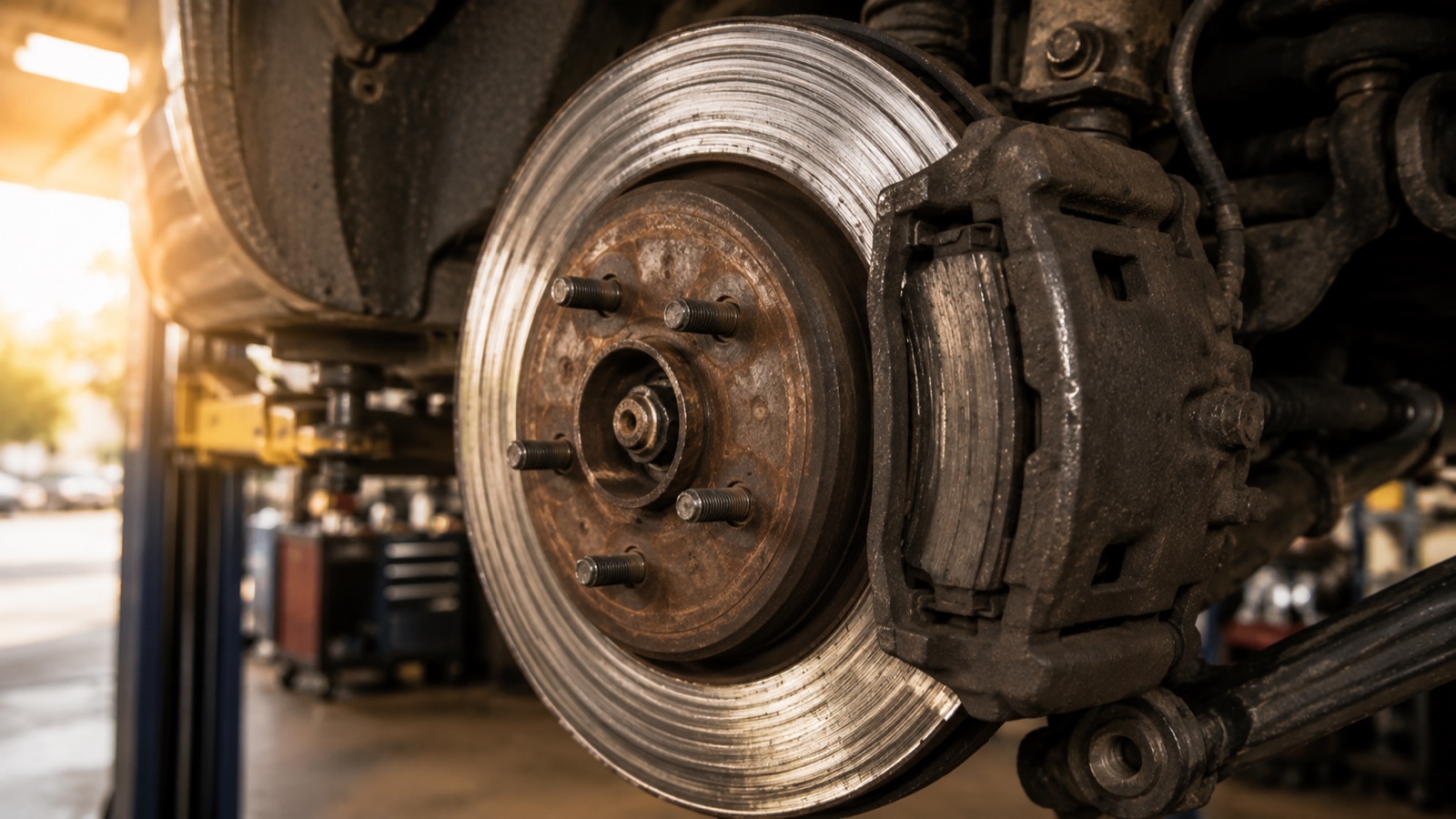
How Dad would explain it
Think of a brake pad like a marker that’s about out of ink — new, there’s a thick pad doing the work; worn, you’re left with a thin sliver before you hit the metal backing. A worn pad looks thin, and it can look shiny, glazed, or cracked from the heat. If yours is squealing, that’s a little metal tab built in telling you it’s getting close — bring it in soon and it’s a cheap fix. If it’s grinding, the pad’s gone and it’s metal on metal, so don’t wait on that one. Swing by and we’ll pull the wheel and show you exactly where your pads stand — free, five minutes, no pressure.
You’re driving home and you hear it. A high-pitched squeal from your wheels, or worse, a grinding that makes your teeth hurt. Maybe you’ve never looked at your brake pads in your life, and now you’re wondering what a worn brake pad even looks like.
Here’s the short version. A worn brake pad is thin. A new pad has a solid chunk of friction material on it, roughly 3/8 to 1/2 inch (about 10 to 12mm). A worn one is down to a sliver, and it can look shiny, glazed, or cracked from all the heat it’s taken. Once that sliver is gone, you’re into the metal backing plate, and that’s where the trouble starts. Let me walk you through what to look for, what those noises mean, and when to bring it in.
What a Worn Brake Pad Looks Like
If you can see your pads through the wheel spokes, here’s what tells the story.
Thin friction material. This is the big one. A healthy pad has a solid chunk of dark material on it. A worn pad looks like a thin sliver of dark sitting on top of the silver backing plate. New is roughly 3/8 to 1/2 inch (about 10 to 12mm). When that dark material is nearly gone, the pad is done.
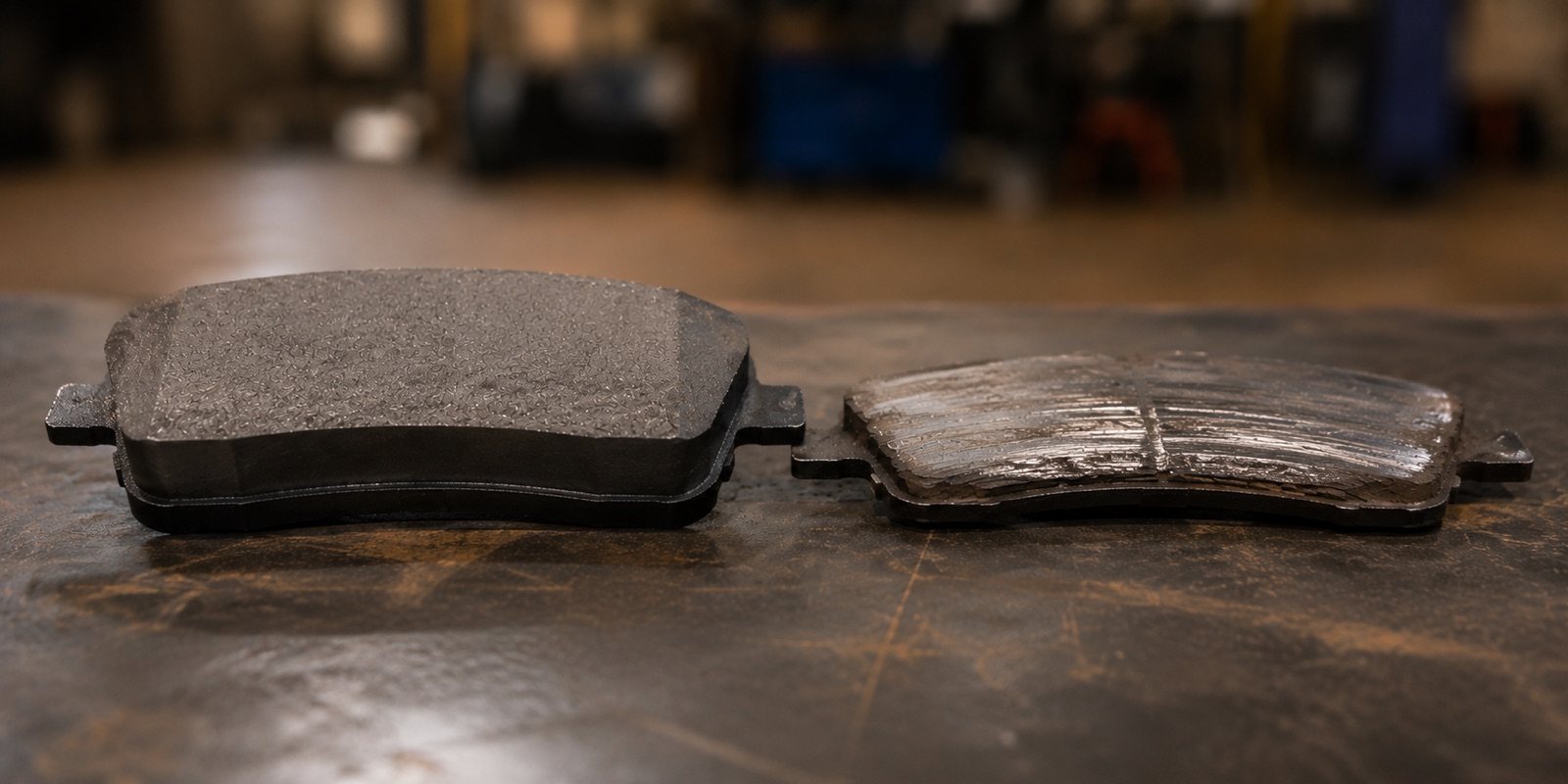
Bare metal showing. If you’re looking at mostly silver backing plate with almost no dark material left, you’re at or past the replacement point. Below about 2mm, it’s metal on metal.
Shiny or glazed. The surface can go slick and glossy when a pad runs too hot for too long. A glazed pad doesn’t grip like a fresh one. Think of it like a tire that’s worn smooth.
Cracks or missing chunks. Heat stress can crack the friction material or knock pieces off it. If you see that, the pad’s had a hard life and it’s at the end of it.
One side thinner than the other. If one pad is way thinner than its partner on the same axle, something’s off — usually a stuck caliper or worn hardware. Worth a look before it eats a rotor.
To check it yourself, park on flat ground with the brakes cool, look through the spokes, and find the pad pressed against the flat metal disc (that’s the rotor). Judge how much dark material sits above the silver plate from the side. A solid chunk means you’re good. A thin sliver means it’s time. Do all four wheels — front and rear wear at different rates. If you can’t tell, that’s what we’re here for. Want the actual numbers? Here’s what counts as good brake pad thickness .
The Squeal: Your Pad’s Built-In Warning
Brake pads come with a little metal tab built right into them. It’s called a wear indicator, and it’s the smartest cheap part on your car.
As the pad wears down, that tab gets closer and closer to the rotor. When the friction material wears down to about 3mm, the tab starts touching the spinning rotor. That contact makes a high-pitched squeal every time you hit the brakes. It’s annoying on purpose.
That squeal is your early warning light. It is not an emergency. It’s your pad politely saying, “Hey, I’m getting close — schedule me soon.” If you bring it in while it’s still squealing, it’s a cheap, simple fix. Don’t put it off for weeks, but you don’t need to panic either.
Squealing vs. Grinding: Know the Difference
This is the part that actually matters, so here it is plain.
Squealing means warning. The wear-indicator tab is kissing the rotor. You’ve got roughly 3mm of pad left. Schedule a brake job soon, but you’re safe to drive in the meantime.
Grinding means gone. The friction material has worn all the way off, and now the metal backing plate is dragging on the rotor. That’s metal on metal, and it’s happening every time you hit the brakes. Each stop chews up the rotor a little more. Your stopping distance can stretch out, and your brakes can get hot enough that they stop working as well as they should.
Grinding isn’t quite call-an-ambulance urgent, but it’s close. Get it looked at right away, because the longer it grinds, the more it costs.
Scored Rotors: What Waiting Actually Costs
Keep driving on gone pads and that metal backing plate carves into the rotor. It leaves deep grooves running around the rotor face — we call that scoring. You can usually see them once the wheel’s off: parallel grooves cut right into what should be a smooth, shiny surface.
Sometimes a scored rotor can be machined smooth again. Sometimes the grooves are too deep and it has to be replaced. Either way, you’ve turned a simple pad job into a pad-and-rotor job.
Here’s the math in real dollars. Brakes start at $180 per axle if we catch it at the squeal. Let it grind into the rotors and you’re looking at pads plus rotors — around $350 or more up front, around $400 or more in the rear. That’s why we keep saying: don’t ignore the squeal. The squeal is the cheap fix. The grind is the expensive one. More on our brake repair and pricing pages.
When to Bring It In
Quick guide on how fast to move.
Schedule soon (a week or two): squealing during braking, a soft or spongy pedal, or pads that look thin through the spokes.
Come in within a day or two: grinding, a pedal that sits low or needs hard pressure, bare backing plate showing, or the car pulling to one side when you brake.
Don’t wait at all: grinding that’s getting worse, a pedal that sinks to the floor, or the red brake light on your dash.
When in doubt, call us at (404) 758-4672 or stop in. We’re in Southwest Atlanta off Cascade Road, and the look is free.
Frequently Asked Questions
What does a worn brake pad look like?
Thin. A new pad has a solid chunk of dark friction material, roughly 3/8 to 1/2 inch (about 10 to 12mm). A worn one is down to a thin sliver on top of the silver backing plate, and it often looks shiny, glazed, or cracked from heat. Once the dark material is gone and you see bare metal, it's past due.
Is squealing the same as grinding?
No, and the difference is your wallet. Squealing is the built-in wear tab telling you the pad's getting thin — schedule service soon, but you're safe to drive. Grinding means the pad is gone and metal is dragging on metal. Grinding needs attention right away.
How worn is too worn?
A healthy pad is roughly 3/8 to 1/2 inch (10 to 12mm). Around 3mm the wear tab starts squealing. Below about 2mm you're into metal-on-metal territory. If you're not sure where yours sit, we'll measure them with calipers for free.
What does it cost to fix?
Brakes start at $180 per axle. If the rotors are damaged too, you're looking at pads plus rotors — around $350 or more in the front, around $400 or more in the rear. Catching it at the squeal keeps you on the cheap end.
Do you warranty the brake work?
We do. Our brake work carries a 10-month or 10,000-mile warranty, whichever comes first. If something isn't right with what we put on, bring it back and we'll make it right.
Don’t Wait Until They’re Grinding
The whole game here is simple: the squeal is your cheap fix, the grind is your expensive one. If you hear that high-pitched squeal in Atlanta traffic, swing by Dad’s Auto Repair Shop in Southwest Atlanta off Cascade Road. We’ll pull the wheel and show you exactly where your pads stand.
Free. No appointment. No pressure. And every brake job we do is backed by our 10-month / 10,000-mile warranty. Give us a call at (404) 758-4672 or book a time, and we’ll get you stopped right and back on the road.