How Dad would explain it
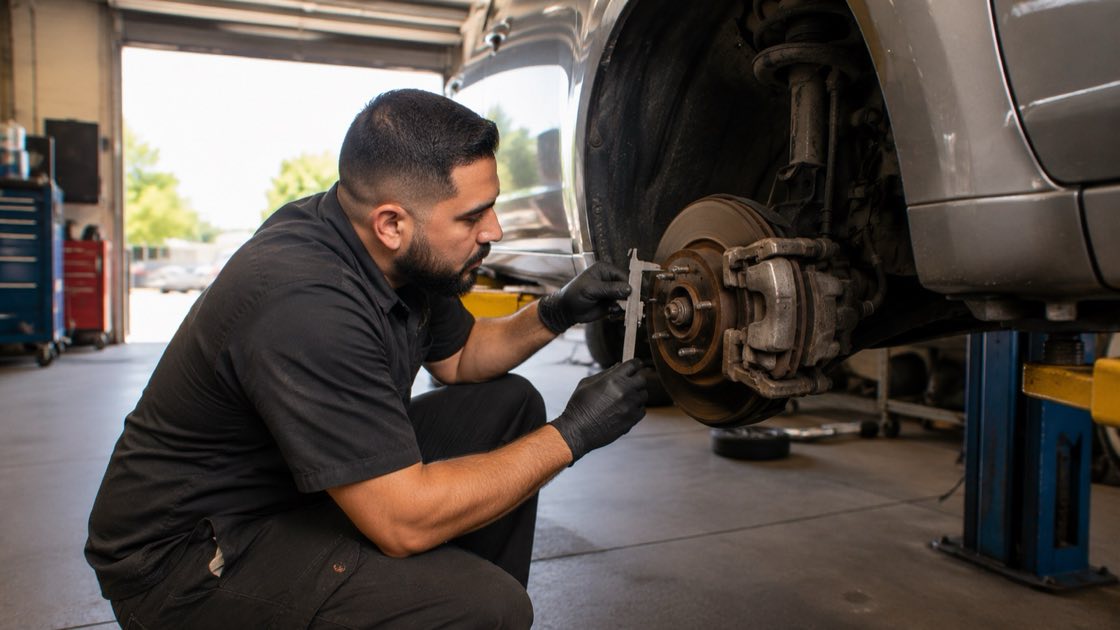
Brand-new brake pads are about 10 to 12 millimeters thick — that’s the part that does the stopping. Every time you brake, a little wears off, so when they get down to 3 or 4 millimeters, that’s when to bring the car in. You’ve still got some pad left, but you’re close to the edge. Wait much longer and the metal starts grinding on the rotor — and now you’re paying for the expensive part instead of a simple pad swap.
Your brake pads wear down a little every time you stop — that’s just the job they do. So a good brake pad thickness comes down to one number: how much pad is left, and when does “thin” become “time to come in.”
Here’s the short version. New pads are about 10 to 12mm. By the time they’re down to 3 to 4mm, plan on replacing them. Under about 2mm is the danger zone — that’s where you risk metal-on-metal and a damaged rotor. So when folks ask what good brake pad thickness is, the honest answer is: anything above 3 to 4mm and you’re fine. At or below that, come see us.
How Thick Are New Brake Pads?
New brake pads are about 10 to 12mm thick. That’s the friction material — the part that presses against the rotor and actually stops the car — plus the metal backing plate it’s mounted to.
Think of a brand-new pencil. It’s long, it writes great, and it lasts a while. But every time you sharpen it, it gets a little shorter. Brake pads are the same. Every stop shaves off a tiny bit of material. Start at 10 to 12mm, and over thousands of stops they work their way down.
Pads start that thick on purpose. More material means more life before you need new ones. It also means the pad sheds heat better and runs cooler, so the whole system holds up longer.
What Is a Good Brake Pad Thickness for Safe Braking?
A good brake pad thickness for everyday driving is anything above 3 to 4mm. At that point you’ve still got real friction material left, you’ve got solid stopping power, and you’ve got a little runway before the next service. That’s the sweet spot to plan a replacement — not a panic, just a heads-up from your car.
At about 2mm, you’ve dropped below safe. The brakes still work, but stopping distances start creeping up and your brakes can fade — that’s when they get too hot and stop grabbing. You’re also a hair away from metal-on-metal, which chews up the rotor.
Below 2mm? You’re riding on fumes. That’s the part where a simple pad job turns into a rotor job. Speaking of which: pads alone start at $180 per axle here. Let it go to metal-on-metal and you’re looking at pads plus rotors — around $350+ front or $400+ rear — because now we’re replacing the rotor, the expensive part. Catch it early and you save the difference. You can see all of it on our pricing page.
How Your Pads Tell You It’s Time
New pads come with a little built-in snitch — a small metal tab called a wear indicator, riveted to the backing plate.
As the pad wears down, that tab gets closer to the rotor. When the friction material is down around 3mm, the tab starts touching the rotor when you brake. That makes a high-pitched squeal. Not loud, not scary — but unmistakable once you know it. That’s your car saying: replace me soon.
That squeal is not an emergency. You’ve got a little time — a week or two, not six months. But don’t tune it out. If you ignore it long enough, the squeal turns into a grind, and a grind means the friction material is gone and metal is sliding on metal. That’s the part that wrecks the rotor. Squeal, you’ve got time. Grind, come in now.
Want to know what a thin pad actually looks like up close? Here’s a closer look: what does a worn brake pad look like.
How to Check Your Brake Pad Thickness at Home
You don’t need fancy tools to get a rough read on your pads. You just need to look. Here’s the wheel-spoke check, start to finish:
- Park on flat ground and let the brakes cool for about 10 minutes — hot brakes are tricky to eyeball.
- Look through the spokes of your wheel at the rotor — that’s the shiny metal disc that spins with the wheel.
- Find the brake pad pressed against the rotor. You’ll see it from the side.
- Thick and healthy looks like a good chunk of friction material — say a half inch or more.
- Thin and worn looks like barely a sliver of material, with mostly silver backing plate showing.
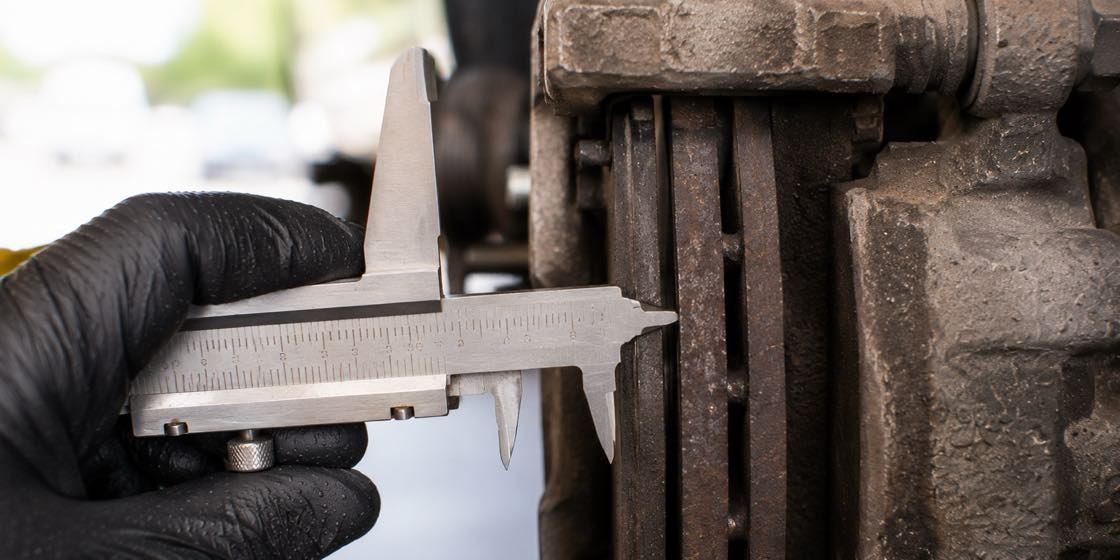
If all you can see is metal backing plate and a thin dark edge, your pads are at or below 3mm. Time to come in. A visual check gets you in the ballpark, but it’s not exact — we measure with calipers to tell you the real number.
When to Come In
Plan on a quick brake check at least once a year — more often if you’re doing a lot of stop-and-go around Southwest Atlanta, since constant braking and summer heat wear pads faster than steady highway miles.
When you bring it by, we pull the wheels, measure pad thickness at all four corners with a caliper, check the rotors, and look over the whole brake system. Then we tell you straight: service now, good for a few thousand more miles, or something else going on. And our brake work is backed by a 10-month / 10,000-mile warranty, so you’re covered after you drive off. No pressure. No upsell. Just the truth about your brakes.
You can book a free brake inspection online, or just call us at (404) 758-4672.
Frequently Asked Questions
What is a good brake pad thickness?
New pads are about 10 to 12mm. Anything above 3 to 4mm is fine for everyday driving. At 3 to 4mm, plan to replace them. Below 2mm is the danger zone — get them looked at right away.
What does the wear indicator do?
It's a small metal tab on the pad. When the pad wears down to about 3mm, the tab touches the rotor and squeals when you brake. That squeal is your signal to schedule service soon.
Is brake squealing an emergency?
No. Squealing means the wear indicator is doing its job. You're safe to drive — just get in within a week or two. Grinding is the one that can't wait.
What's the difference between squealing and grinding?
Squealing is an early warning that your pads are getting thin. Grinding means the material is gone and metal is on metal. Grinding damages the rotor with every stop — come in right away.
How long do brake pads last around Atlanta?
Depends how you drive. Steady highway miles might get you 70,000. All that Southwest Atlanta stop-and-go, plus summer heat, usually puts folks closer to 25,000 to 40,000.
Can I check my brake pads myself?
You can get a rough idea. Look through the wheel spokes at the pad from the side. Mostly silver backing plate and a thin dark sliver means they're getting low. For an exact number, bring it by and we'll measure with calipers.
Come See Us
That squeal isn’t your car being annoying — it’s your car talking to you. Catch your pads at 3 to 4mm and a brake job is quick and simple. Wait for the grind and you’re paying to replace the rotor too.
Stop by Dad’s Auto Repair Shop in Southwest Atlanta. We’ll measure your pads, tell you exactly where you stand, and give you a real price before we touch anything. Book a free inspection or call (404) 758-4672. No guessing. No surprises.