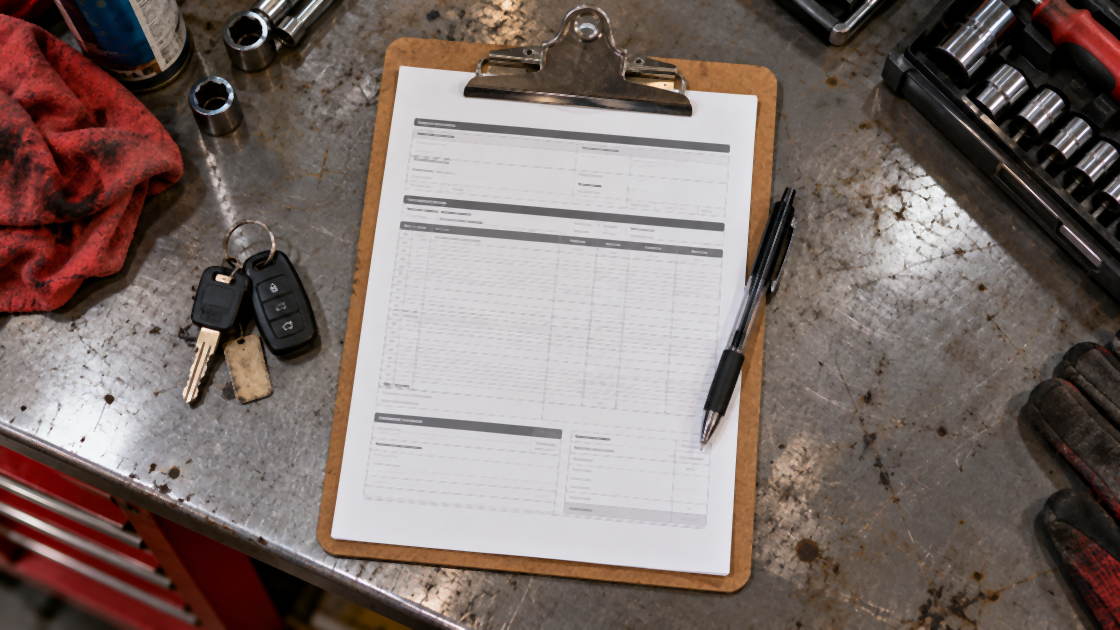
How Dad would explain it
An estimate looks complicated for the same reason a phone bill looks complicated. It is mostly three things repeated, with codes and abbreviations laid over the top.
On a phone bill it is the plan, the devices, and the taxes. On a repair estimate it is the parts, the labor, and the fees. Once you know which line is which, the whole page gets simple.
You are not trying to become a mechanic. You are trying to answer one question: does this list match what I came in for.
Somebody hands you a sheet of paper with twelve lines on it and a total at the bottom, and you have about forty seconds to decide whether it is fair. That is a bad spot to be in.
So here is the short version. An estimate only ever contains three kinds of lines: parts, labor, and fees. Everything else is description. Read it in that order and you can check it yourself in a couple of minutes.
We will go line by line, show you where padding usually hides, and give you four questions that make any estimate in Atlanta easier to judge.
Want us to look at one you already have? Set up your visit today.
Start at the Top, Not the Bottom
Most people read the total first and work backward from the shock. Read it the other way.
The top of the estimate should say what you came in for. Your year, make, model, mileage, and a plain description of the complaint: noise when braking, oil change due, check engine light on.
If that part is wrong or vague, nothing underneath it is going to make sense. An estimate that says “brake service” with no description of what was found is a bill, not an estimate.
The Parts Lines
Parts lines are physical things that stay on your car. Pads, rotors, filters, plugs, wipers, a battery, a belt.
Each one should have a quantity and a price. Quantity matters more than people think. Brake pads come in sets, and rotors come one per wheel, so a front rotor line should say 2, not 1.
Three things to look for:
- Is the quantity right for the job? Two rotors per axle. One oil filter. Four or six spark plugs depending on the engine.
- Does it say what grade of part? Economy, ceramic, or original-equipment pads are different products at different prices. We wrote about ceramic versus OEM brake pads if you want that comparison.
- Is there a warranty on the part? Ours are insured for 10,000 miles or 10 months. That should be written down somewhere, not just said out loud.
The Labor Lines
Labor is time. Almost every shop prices it as an hourly rate multiplied by a number of hours the job is supposed to take.
Our labor rate is $95 an hour for anything not already priced as a flat job. Oil changes, brakes, tune-ups, and emissions tests at Dad’s Auto Repair Shop are flat-priced instead, so you see one number rather than a rate and a guess.
The thing to watch on labor lines is double counting. If the estimate charges labor to pull a wheel off for a brake job and then charges labor again to pull the same wheel off for an inspection, somebody is billing the same minute twice. One ask clears it up: “is any of this labor overlapping?”
The Fee Lines at the Bottom
This is where most of the surprise lives. Common ones are shop supplies, environmental or disposal fees, a percentage-based miscellaneous charge, and then sales tax on top of all of it.
Individually they look small. Stacked up, a $300 estimate can land near $360 at the counter.
At Dad’s those lines do not exist, because every price we quote is out the door, with tax and shop fees already inside it. When we say $88 for a full synthetic oil change, you hand us $88. We explained the whole approach in what out the door pricing actually means.
Where Padding Usually Hides
Padding is rarely a fake line. It is usually a real line that did not need to be there yet.
| What you see | What to ask |
|---|---|
| Rotors added to a pads job | Were the rotors measured, or assumed? |
| A fluid flush you did not ask about | Is it due by mileage, or does it look bad? |
| ”Shop supplies, 10%“ | Is that a flat fee or a percentage of the whole bill? |
| Labor listed twice on nearby jobs | Is any of that time overlapping? |
| A diagnostic fee plus a repair fee | Does the diagnostic come off if I do the work here? |
| Parts with no grade listed | Which pad is this, and what is the warranty? |
None of those are automatically wrong. A shop can have a good answer for every one. The point is that you get to hear the answer before you agree, not after.
For a baseline to read anybody else’s sheet against, here is what our common work costs, out the door.
| Service | Out the door |
|---|---|
| Full synthetic oil change (up to 5 qts) | $88 |
| Synthetic blend oil change (up to 5 qts) | $56 |
| Brake pads, per axle | from $180 |
| Pads and rotors, front axle | from $350 |
| Pads and rotors, rear axle | from $400 |
| Scheduled tune-up | from $250 |
| Georgia emissions test | $20 |
| Tire rotation | $30 |
| Labor, anything not flat-priced | $95/hour |
The full list lives on our pricing page.
The Four Questions That Make Any Estimate Readable
Ask these four and almost every confusing estimate sorts itself out.
- Is this number out the door, with tax and shop fees?
- What on here is needed now, and what is a recommendation?
- Was anything measured, or is it assumed?
- Is there a warranty on the parts and the labor?
A shop worth using answers all four plainly. If the sheet gets vague when you start asking, that is useful information on its own.
What Our Estimates Look Like
Short, and in plain English. What we found, what it costs, and what it costs out the door, which is the same number.
If parts have to be ordered for your car, there is a $50 parts deposit, and that deposit is credited to your final bill. It is not an extra charge, and you hear about it before anything is ordered. Same-day service, when we have to pull your car in immediately instead of on a scheduled day, is a flat $50 per visit.
Sometimes the estimate is a short conversation that ends with us saying nothing needs doing yet. That happens often enough around West End and Adair Park that people are still surprised by it.
What We Do Not Put On an Estimate
We are a preventative maintenance shop. Oil changes, brakes, scheduled tune-ups, Georgia emissions testing, tire rotations and plugs, wipers, filters, fluids, batteries, belts, and reading diagnostic codes.
We do not do engine repair, transmission work, air conditioning, alignments, electrical, body work, glass, cooling-system repair, or hydraulic brake and ABS repair. If your estimate from somewhere else is for one of those, we will say so and point you to somebody in Atlanta who does that work, rather than writing it up ourselves.
Frequently Asked Questions
What are the three parts of a repair estimate?
Parts, labor, and fees. Parts are the physical items that stay on the car, labor is time billed at an hourly rate or as a flat job, and fees are shop supplies, disposal, and tax. At Dad's, fees and tax are already inside the quoted price.
How do I know if an estimate is padded?
Check quantities, ask whether anything was measured or assumed, and ask what is needed now versus recommended. Padding usually looks like a real line added early rather than a fake line.
Do you charge for an estimate?
No. Tell us the year, make, and model and what the car is doing, and we will give you a real number before anything starts.
What is a shop supplies fee?
A charge for the small consumables a job uses, sometimes flat and sometimes a percentage of the bill. We do not list one, because it is already inside our out the door price.
Is the $50 parts deposit an extra charge?
No. When parts have to be ordered for your car we take a $50 deposit, and it is credited to your final bill. You are told about it before anything is ordered.
Can you explain an estimate from another shop?
Yes, as long as the work is in our scope. Bring it by and we will read it with you and tell you what the job should cost. If it is engine, transmission, or AC work, we will tell you that plainly and point you elsewhere.
Come See Us
Bring the estimate, or bring the car, to 2270 Cascade Road in Southwest Atlanta and we will read it with you line by line. We are open Monday through Friday 8 AM to 6 PM with the last appointment at 5:30, and Saturday 9 AM to 2 PM. Book an appointment or reach out with a question anytime.