How Dad would explain it
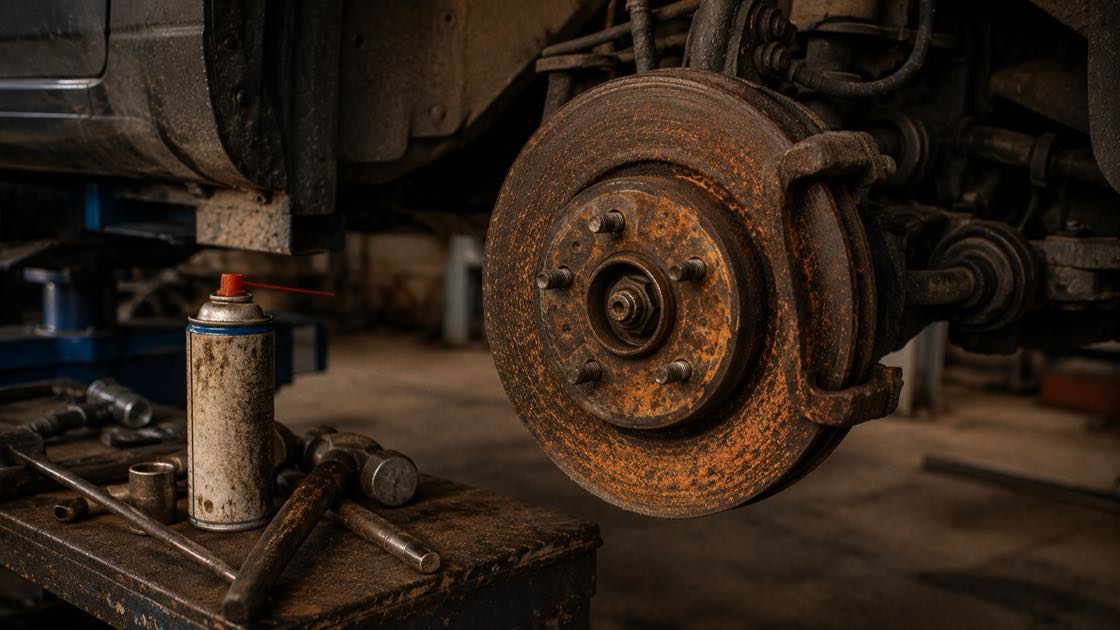
Your rotor won’t come off the hub, and you’re about ready to grab a hammer. Don’t. Nine times out of ten it’s just rust — the rotor and hub have been sitting in Atlanta humidity and basically rusted themselves together. Soak the seam with penetrating oil, give it 20 minutes, tap around the edge with a rubber mallet, and if your rotor has those little threaded holes, run a couple bolts in to push it off evenly. If it still won’t let go — or the threads strip, or something looks off — quit while you’re ahead and bring it by. We pull stuck rotors every week.
You’ve pulled the wheel, pulled the caliper, and you’re standing there with a stuck brake rotor that won’t slide off the hub. Happens all the time. Almost always it’s just surface rust — the rotor and the hub have been pressed against each other, sweating it out in Atlanta’s humidity, and a thin layer of rust has glued them together. It’s not broken. It’s not something you did wrong. The fix is penetrating oil, a little patience, and a rubber mallet — and if your rotor has threaded holes, a couple of bolts to push it off clean. No sledgehammer required. Here’s how to do it right.
Why Rotors Stick in the First Place
A brake rotor sits flat against a steel hub. Two bare metal surfaces, pressed together, in a part of the country that stays damp most of the year. That’s all rust needs.
Down here in Southwest Atlanta, humidity is the real culprit. Folks up north fight road salt all winter — we mostly don’t. Atlanta only salts now and then during an ice event, so that’s rarely what’s gluing your rotor down. It’s the moisture in the air, day after day, working on bare metal.
The longer a car sits, the worse it gets — a vehicle parked for a year can have a rotor that feels welded on. Heat plays a part too: drive hard, then park, and the metal cools and sweats, and rust forms a little faster. It’s just rust doing what rust does.
How to Remove a Stuck Brake Rotor: The Steps
The short version: spray penetrating oil into the seam where the rotor meets the hub, let it soak 20 minutes, tap around the edge with a rubber mallet, then — if your rotor has threaded jacking holes — run two bolts in evenly to push it off. That gets most rotors loose. Here’s the longer version.
Step 1: Get the Car Safe
Park on level ground. Set the parking brake. Put it in Park (or in gear, if it’s a manual). Get it up on jack stands — never trust a jack by itself — and chock the wheels still on the ground. Then pull the wheel.
Step 2: Get the Caliper Out of the Way
You’ve likely already done this to get at the rotor. Remove the caliper and, if needed, the caliper bracket, and set them aside. Don’t let the caliper dangle by the brake hose — hang it from a bungee or a piece of wire so you’re not stressing the line.
Step 3: Soak the Seam With Penetrating Oil
This is the step that does most of the work, so don’t rush it. Reach for a real penetrating oil — PB Blaster, Kroil, or Liquid Wrench. Those are made to creep into rust and break the bond. Spray it right into the seam where the rotor meets the hub, and get some into the center bore (the hole in the middle) where the rotor rides on the hub.
A quick note on WD-40: in a pinch it’s better than nothing, but it’s really a water-displacer, not a true penetrant. If a real penetrating oil is on the shelf, grab that instead.
Now let it sit — 15 to 20 minutes at least. Longer is fine; an hour, even overnight, won’t hurt. The oil needs time to work its way into the rust.
If you’ve soaked it and it still won’t move, that’s a fine place to stop and let us handle it. We pull stuck rotors every week, and it’s usually a quick job once the car’s on the lift.
Step 4: Tap Around the Edge
After it’s soaked, take a rubber mallet and tap your way around the outer edge of the rotor where it meets the hub. Gentle taps, not hammer blows. You’re trying to crack the rust bond loose, not beat the rotor into submission.
Start at one spot, tap a few times, move over, tap again. Work all the way around. No rubber mallet? A regular hammer with a block of wood held against the rotor works — the wood spreads the force so you don’t gouge anything.
Step 5: Use the Threaded Holes, If You’ve Got Them
Here’s the trick that does it cleanly when it’s available.
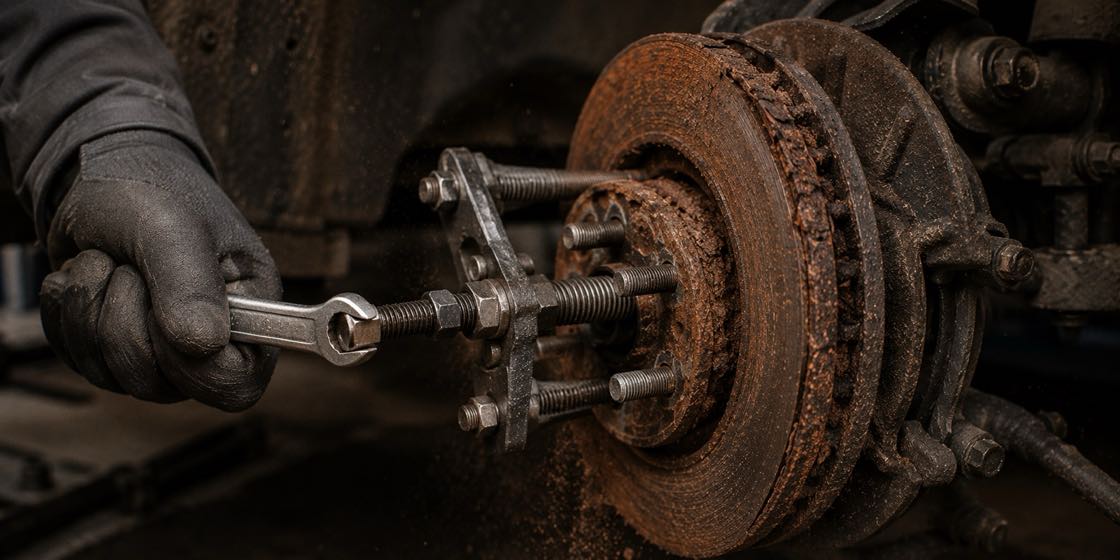
Many rotors — this is common on a lot of European cars and some others — have a couple of threaded jacking holes near the center. They’re put there for exactly this: you thread bolts in, and the bolts push against the hub and walk the rotor off evenly. Plenty of rotors don’t have them, though, so take a look at the center of yours before you count on this.
If yours has them, thread in bolts that match the hole size (often 6mm or 8mm). Tighten a little at a time, going back and forth so the pressure stays even — a quarter turn on one, a quarter turn on the other. You’ll usually hear a sharp crack when the rust lets go and the rotor breaks free.
No threaded holes? Don’t go improvising with pry bars and big hammers. That’s exactly the case where a shop with a proper rotor puller earns its keep. (More on that below.)
Step 6: Pull It and Clean Up
Once it’s loose, slide the rotor straight off. If you’re putting on a new one — and if you went to all this trouble, you probably are — wire-brush the hub face clean first. A light coat of anti-seize on the hub surface keeps the next rotor from welding itself on, and you’ll thank yourself in a couple of years.
A Word About Your Brakes
Getting the rotor unstuck is just knocking loose some surface rust — that part’s not a big deal. But brakes are brakes. If you end up disturbing anything in the hydraulic side of the system — a caliper, a hose, a bleeder — it has to go back together correctly and get bled properly before the car moves. Brakes aren’t a “good enough” job. If any of that gets into the picture and you’re not sure, stop and let someone who does it every day finish it.
Tools That Help (and Tools to Leave Alone)
Reach for:
- Penetrating oil — PB Blaster, Kroil, or Liquid Wrench (WD-40 only in a pinch)
- Rubber mallet, or a hammer with a wood block
- Bolts that fit the threaded holes, if your rotor has them (usually 6mm or 8mm)
- A wrench or socket set
- Wire brush
- Anti-seize, for reassembly
Leave alone:
- Sledgehammers — too much force. You’ll damage the rotor or hub, or knock something loose you didn’t mean to.
- Torches — no. You’re right next to brake lines and fluid. Heat and brake hydraulics don’t mix.
- Grinders or cutoff wheels — cutting a stuck rotor up just trades one problem for a bigger one.
- Prying with a screwdriver — a good way to slip and gouge your hand or the rotor.
When to Stop and Call a Pro
There’s no shame in this — knowing when to quit is half of doing it right. Bring it in if:
- The threads strip. Once the threaded holes are chewed up, you can’t push the rotor off that way. We have other tools.
- The rotor has no threaded holes. Some rotors just don’t, and forcing one off without the right puller usually ends in damage. A shop with a rotor puller handles this in minutes.
- The rotor is cracked or warped. Wrestling a damaged rotor off can do more harm. Let a pro look.
- The hub itself is badly corroded. If the hub face is pitted or damaged, the new rotor may not seat true. That needs a real assessment.
- Other brake hardware is frozen — caliper, bracket, slide pins. If more than the rotor is stuck, the job’s bigger than a stuck rotor.
When any of that shows up, bring it by Dad’s. We’ve done this hundreds of times, we’ve got the right tools, and we can usually turn it around the same day. Labor is $95/hour, and most stuck rotors are off in 30 to 60 minutes once the car’s on the lift — so figure roughly $95 to $190 in labor, and we’ll quote you the real number before we start.
Frequently Asked Questions
How long should I let penetrating oil soak?
Fifteen to twenty minutes is usually plenty. Longer is fine — some folks let it sit overnight. The oil needs time to creep into the rust, so give it a few minutes rather than spraying and yanking right away.
Can I just use a sledgehammer?
Please don't. Too much force damages the rotor, the hub, or the brake hardware sitting right there. Gentle taps with a rubber mallet, or the threaded-hole bolts, get it done without the wreckage.
Can I heat it with a torch?
No. You're inches from brake lines and brake fluid. Heat near the hydraulics is asking for trouble. Penetrating oil and patience do the same job safely.
My rotor doesn't have threaded holes. Now what?
A lot of them don't. Without those holes you really want a proper rotor puller — that's a shop tool. Forcing it usually just causes damage, so bring it in and we'll pop it off.
How do I keep this from happening again?
A light coat of anti-seize on the hub face when you install a new rotor goes a long way. Driving the car regularly helps too — a car that sits for months in our humidity is where the worst rust shows up.
Why do my rotors stick so much down here?
It's the climate. Southwest Atlanta stays humid most of the year, and damp air on bare metal is all rust needs. It's not you — it's the weather.
Don’t Wrestle With It
A stuck rotor is annoying, but it’s almost always just rust, and rust gives up to penetrating oil and a little patience. Soak it, tap it gently, use the threaded holes if you’ve got them, and most rotors come free inside an hour.
If it won’t cooperate — or you’d just rather not spend your Saturday on it — bring it by Dad’s here in Southwest Atlanta, or call us at (404) 758-4672. We pull stuck rotors every week, and we’ll have you back on the road with brakes you can trust.