How Dad would explain it
Brake shoes are the curved pads inside a drum brake, and they wear down a little every time you stop — like a pencil getting shorter the more you write. A new one has about 4 to 5 millimeters of friction material; once it’s worn to around 1 to 1.5mm (about a dime’s thickness), it’s time for new ones before you’re grinding metal on metal. The catch with drum brakes is you can’t see the shoes without pulling the drum, so most folks don’t know until they hear grinding or the parking brake gets weak. If you’ve got the tools and a jack stand you can check them yourself — but if a drum’s rusted on tight or you’re not sure what you’re looking at, swing by and we’ll take a look. No charge to have a conversation.
Drum brakes are still on plenty of vehicles around Southwest Atlanta — trucks, SUVs, and a lot of older economy cars. They’re more of a mystery to most people than disc brakes, because the parts you’d want to look at are hidden inside the drum.
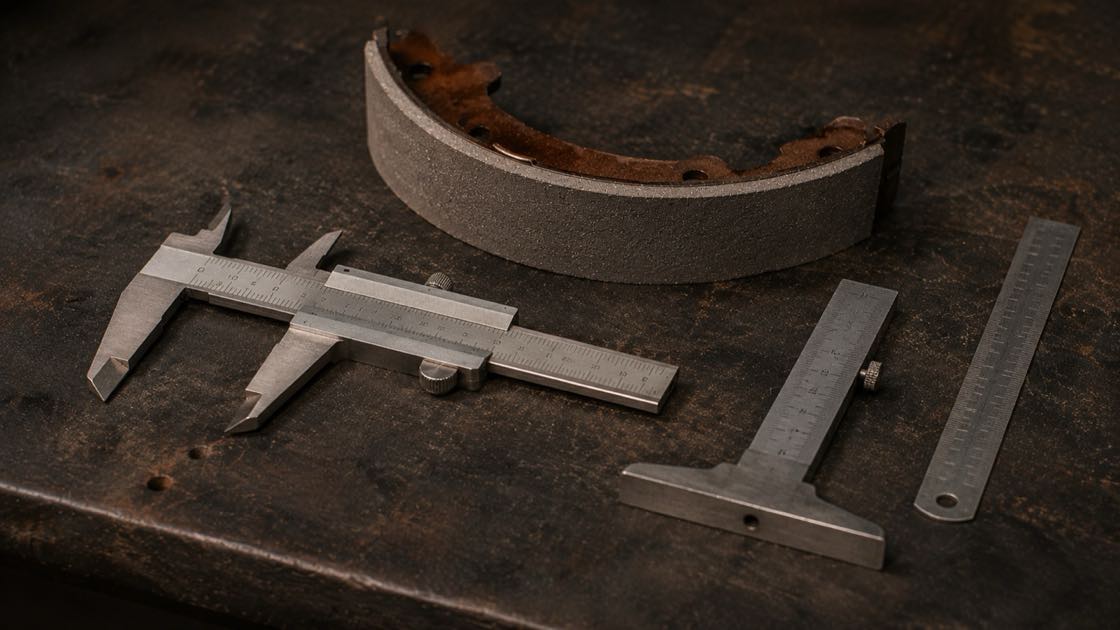
To measure brake shoe thickness, you pull the drum off and check the friction material with a gauge or a ruler. New shoes carry about 4–5mm of material. You replace them once they wear down to around 1–1.5mm — about a dime’s thickness. On riveted shoes, you replace them before the lining wears down near the rivet heads. And whatever the gauge says, always defer to your vehicle’s spec. That’s the short version. Here’s the longer one.
First, the honest part: most folks are better off letting a mechanic do this
I’ll say this before the how-to, because brakes are a safety system and I’d rather be straight with you. Measuring brake shoes means getting under the car, pulling a wheel, and wrestling off a drum that may be rusted on tight, then reading worn parts in bad light. If you’re handy and you’ve got jack stands, you can absolutely check them yourself — I’ll walk you through it below. But if any of that makes you nervous, that’s a good instinct. There’s no shame in letting someone look who does this all the time. Brakes aren’t the place to guess. If you want the background first, here’s what a brake shoe actually is.
Brake shoe thickness: the basic numbers
These are the numbers worth keeping in your head. When in doubt, your vehicle’s service spec wins over any rule of thumb.
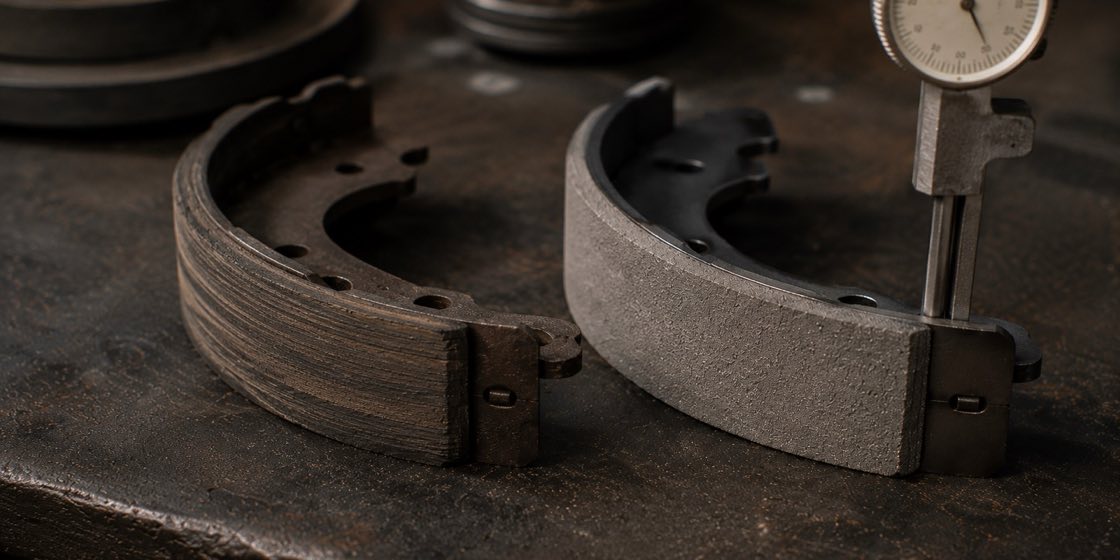
- New shoes: about 4–5mm of friction material — roughly a couple of credit cards stacked together.
- When to replace: around 1–1.5mm left, about a dime’s thickness. Under that, you risk metal-on-metal contact, which chews up the drum and makes braking unreliable. Don’t push your luck past a dime.
- Riveted shoes: these have rivets sitting just below the surface of the lining. Replace them before the lining wears down near the rivet heads — once the rivets are about to touch the drum, the shoes are finished.
The tools you’ll need
Nothing exotic:
- A jack and jack stands (never just the jack)
- A lug wrench
- A brake lining thickness gauge — about $10–20 online — or a small ruler held carefully against the shoe
- A drum micrometer or brake drum gauge if you want to check the drum too
- A spray bottle of water or a can of brake cleaner, plus rags
How to measure brake shoe thickness, step by step
Step 1: Raise the vehicle safely
Lift it with a jack, then set it down on jack stands. Don’t trust the jack alone — if it slips while you’re under there, you can get badly hurt. Get the rear wheel off the ground and make sure the vehicle is solid before you reach under it.
Step 2: Remove the wheel
Crack the lug nuts loose while the tire is still on the ground, then pull the wheel once it’s lifted and secured.
Step 3: Remove the drum
The shoes live inside the drum, which either bolts to the hub or slides off the axle flange. Here’s where it gets ornery: drums get stuck from rust and corrosion, and around here they get stuck plenty. Sometimes a couple of taps frees it; sometimes you need a drum puller. If it won’t budge and you find yourself reaching for a bigger hammer, that’s your sign to stop and bring it in. A fought-with drum is an easy way to damage parts or yourself.
Step 4: Clean out the brake dust — the right way
There’s brake dust coating everything inside a drum, and you have to clear some of it to read the shoes. Never blow it out dry with compressed air. On older vehicles that dust can contain asbestos, and blowing it dry sends it straight into the air you’re breathing. Do it the safe way instead: dampen the dust with a little water and wipe it out with a rag, or hose it down with brake cleaner and wipe. Keep it wet, and dispose of the rag properly.
Step 5: Measure the friction material
Measure the thickness of the friction material on each shoe. A brake lining gauge is easiest, but a ruler held square against the shoe will get you close. Check a few spots across the width — shoes wear unevenly, and the thinnest spot is the one that counts. Compare what you read against the numbers above and against your vehicle’s spec.
Step 6: Measure the drum (while you’re in there)
Look on the inside edge or back of the drum for a stamped number — that’s the maximum diameter it can safely be machined to. With a drum micrometer, measure the current inside diameter. If it’s at or past that max, or it’s deeply scored, the drum needs replacing too, not just the shoes.
When to check your brake shoes
You don’t have to crawl under the car every weekend, but don’t wait for a failure either. Get the rear drums looked at if:
- You hear grinding from the rear — that’s often metal-to-metal, so don’t sit on it
- The parking brake feels weak — on many vehicles it works through the rear shoes
- The brake pedal feels soft or low
- The car pulls to one side when you brake
When to just bring it in
Pulling a drum, reading worn shoes, checking the springs, hardware, and wheel cylinders, then getting it all back together and adjusted right — it’s a detailed job on a safety system. I’ll be straight with you: involved drum and shoe work isn’t a standard service I take on at Dad’s. It needs the right setup to do properly, and I’d rather tell you that than do it halfway.
So here’s my honest offer. If you want a second set of eyes on your brakes, come by. I’ll give you a straight read. If it’s something I can help with, I will. If it’s better handled somewhere else, I’ll tell you that too — and point you toward someone I trust. No charge to have a conversation. If there’s work I can take on, the rate is $95/hour plus parts. You can read more about how we handle brake repair anytime.
Frequently Asked Questions
How thick should brake shoes be?
New brake shoes are about 4–5mm thick. Plan to replace them around 1–1.5mm — roughly a dime's thickness. On riveted shoes, replace before the lining wears down near the rivet heads. Always defer to your vehicle's spec for the exact limit.
How do I know if my brake shoes need replacing?
Common signs are grinding from the rear wheels, a weak parking brake, the car pulling to one side when braking, or a soft brake pedal. If you notice any of those, get them checked.
Can I measure brake shoe thickness myself?
You can, if you've got jack stands and the right tools. It means pulling the drum — which can be stuck — and reading the shoes carefully. Brakes are a safety system, though, so if you're at all unsure, most folks are better off letting a mechanic handle it.
Why can't I just blow the brake dust out with compressed air?
Because on older vehicles that dust can contain asbestos, and blowing it dry puts it in the air you breathe. Dampen it with water and wipe it down, or use brake cleaner instead.
What's the difference between brake shoes and brake pads?
Brake pads belong to disc brakes — they squeeze a rotor, usually at the front. Brake shoes belong to drum brakes — they press outward against the inside of a drum, usually at the rear of many trucks and SUVs.
Do I need to replace the drum if the shoes are worn?
Not always. If the drum is still within its stamped max diameter and isn't badly scored, it can stay. If it's at the limit or grooved up, it needs replacing along with the shoes.
Before you crawl under there
Drum brakes are easy to ignore because you can’t see them, but they stop your car just like the discs up front, so they’re worth checking.
If you want to take a look yourself, go for it — take your time and keep that brake dust wet. And if a drum won’t come off, or you get under there and aren’t sure what you’re seeing, don’t sweat it. Give us a call at (404) 758-4672 or stop by here in Southwest Atlanta. No charge to have a conversation, and if it’s better handled elsewhere, I’ll send you to someone good.