Here’s the question we get more than any other in the shop: “How often do I really need to change my oil?” Usually it’s asked nervously, like the customer already knows they’re about to get sold something they don’t need.
The honest answer is shorter and cheaper than what most people get told. So let’s just say it: for most cars on the road today, every 5,000 miles or 5 months — whichever comes first. Not 3,000. Not “as soon as the dealer’s dashboard sticker says.” Five thousand.
If you want to know why, and how to know when it’s actually time for your specific car, keep reading.
The 3,000-mile myth and where it came from.
The “every 3,000 miles” rule comes from a time when engines and oil were both very different than they are today. In the 1970s and 80s, motor oil was conventional — meaning it broke down faster, picked up contaminants quicker, and lost its ability to lubricate after a few thousand miles. Engines were also built with looser tolerances, so they were harder on oil to begin with.
So a 3,000-mile oil change interval made sense — for a 1978 Chevy.
For a 2018 Honda? Not so much.
Modern full synthetic oil is built differently. The base molecules are engineered for stability, the additive package is more sophisticated, and the whole system is designed to handle 5,000–10,000 miles depending on the formulation. Modern engines are also built tighter, run cleaner, and put less stress on the oil.
“If you’re driving a car built after 2010 and using full synthetic, you’re almost certainly fine going 5,000 miles. Sometimes longer. The 3,000-mile rule is a habit, not a science.”
What we actually recommend at Dad’s.
At our shop, we tell most customers to come back every 5 months or 5,000 miles, whichever comes first. That accounts for two important things:
Mileage matters. Driving wears oil down through heat cycling, contaminants, and physical breakdown. The more you drive, the more your oil works.
Time matters too. Even if you barely drive, oil oxidizes over time. The “I only put 2,000 miles a year on my car” person still needs to come in — just on a calendar schedule instead of a mileage schedule.
That 5/5 rule covers most Atlanta drivers we see — folks commuting on I-285, doing errands around Cascade, dropping kids at school, or making the occasional trip up to Decatur or Buckhead. If your driving pattern is unusual (we’ll get to that), the interval shifts a bit.
How to actually know if you’re due:
Check your owner’s manual. Yes, really. It’s the most accurate source for your specific car. Most modern owner’s manuals recommend 5,000–7,500 miles for normal driving and 5,000 for “severe” driving.
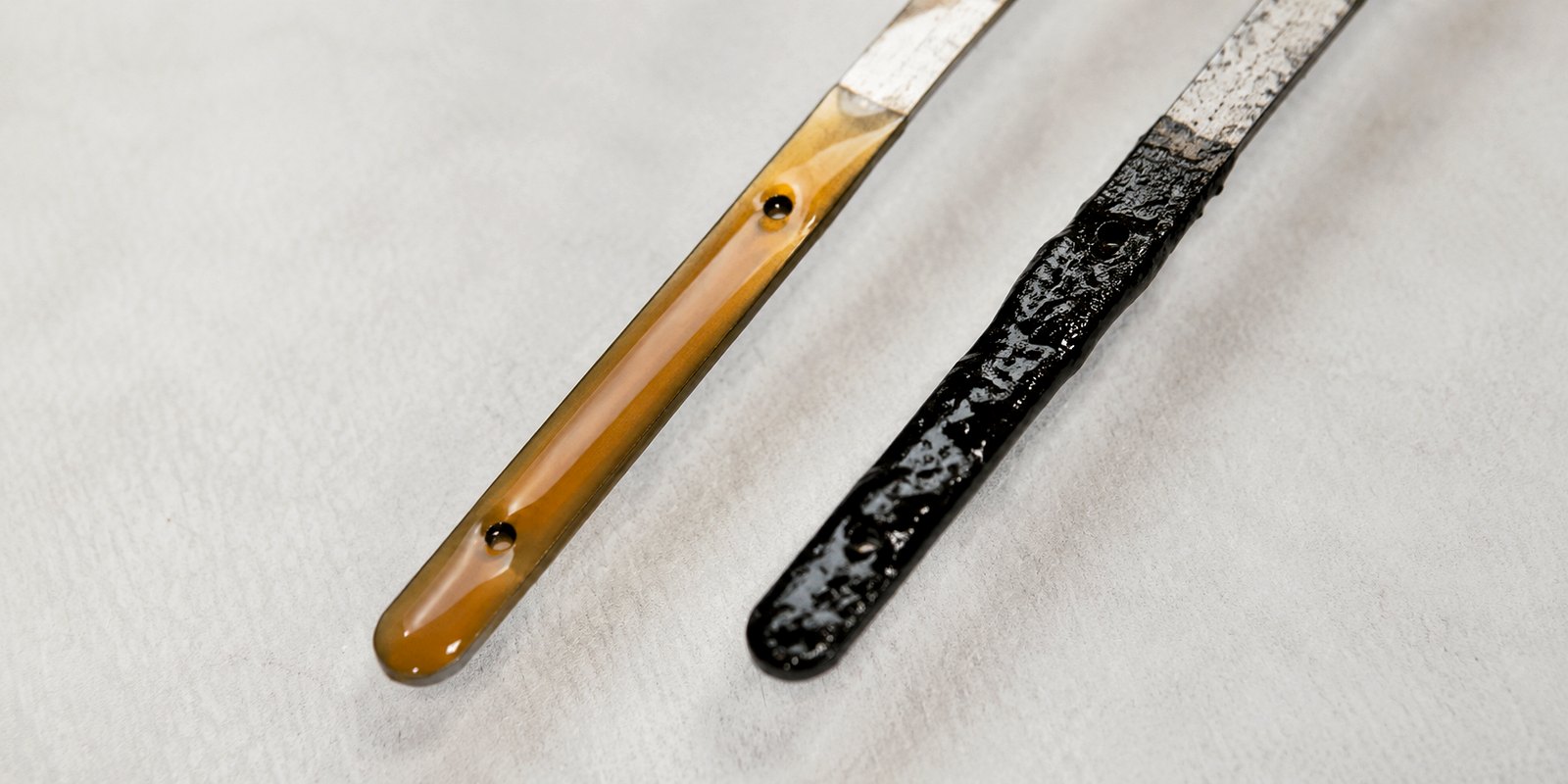
Look at the oil itself. Pull the dipstick and wipe it. If the oil is still amber and translucent, you’ve got time. If it looks like coffee or feels gritty between your fingers, you’re overdue.
Listen to your engine. Rough idle, slightly louder operation, or a small drop in fuel economy can all mean it’s time.
Ignore the windshield sticker. Most shops set the next-change reminder at 3,000 miles because it makes them more money. If you’re following the sticker, you’re probably changing your oil twice as often as you need to.
What about severe driving conditions?
“Severe” is a term that gets thrown around a lot, and it’s important to understand what it actually means — because it changes your interval. According to most manufacturers, severe driving includes:
- A lot of stop-and-go traffic (most Atlanta commuters qualify here)
- Frequent short trips under 10 minutes (the engine never fully warms up)
- Towing or carrying heavy loads regularly
- Driving in extreme heat or cold for extended periods
- Dusty or off-road driving conditions
If two or more of those apply to you, lean toward the shorter end of the range — say 4,000–5,000 miles instead of 5,000–7,500. For most folks who commute on the Atlanta perimeter daily and do a lot of city driving, “severe” actually applies, even if it doesn’t feel like it. The good news: 5,000 miles handles severe driving fine for most modern engines on full synthetic.
Need an oil change?
Our standard is $88 full synthetic — out the door, tax included, fits most modern cars. Synthetic blend ($56) when your manual permits it, multi-grade synthetic ($98) when your spec calls for it. New filter, fluid top-offs, multi-point inspection. In and out in 30 minutes.
What if my dealer says I need to come in every 3,000 miles?
Some dealers still recommend 3,000-mile intervals. It’s not a coincidence that they make money every time you come in. There are a few reasons they might say it:
- Outdated playbook. Some service departments haven’t updated their recommendations since the 90s.
- Conservative liability stance. Recommending more frequent changes is hard to fault even if it’s unnecessary.
- It’s profitable. Twice as many oil changes is twice as much revenue per customer.
If your owner’s manual says 5,000 or 7,500 miles and your dealer is telling you 3,000, trust the manual. The manual is what the engineers who built your car wrote. The 3,000-mile recommendation is what the service writer was trained to upsell.
Synthetic vs. conventional — does it matter?
Yes, but probably not in the direction you’d think. Most modern cars built after about 2010 either require or strongly recommend full synthetic oil. Some manufacturers (BMW, Mercedes, many newer Hondas) actually void warranties if you use conventional oil. So for most cars on Atlanta roads today, “synthetic vs. conventional” isn’t really a choice — it’s full synthetic, period.
If you have an older car (pre-2010) that’s been running fine on conventional oil, it’s probably fine to keep using it — just change it more often, every 3,000–4,000 miles. Or switch to synthetic and extend your interval to 5,000. The math usually works out about the same.
The bottom line.
Don’t let anyone scare you into more oil changes than you need. But also don’t push it past 7,500 miles unless your owner’s manual specifically allows it — at that point you’re really gambling with your engine. Find the right interval for your car, your driving, and stick to it.
And if you ever find yourself in a shop where someone is recommending a $40 oil change “package” with a $200 list of upsells stapled to it — find a different shop. There are plenty of places (including ours, but plenty of others too) where you can get a real, honest oil change at a real, honest price, and walk out with your car running better than when you came in.
That’s the whole job.